
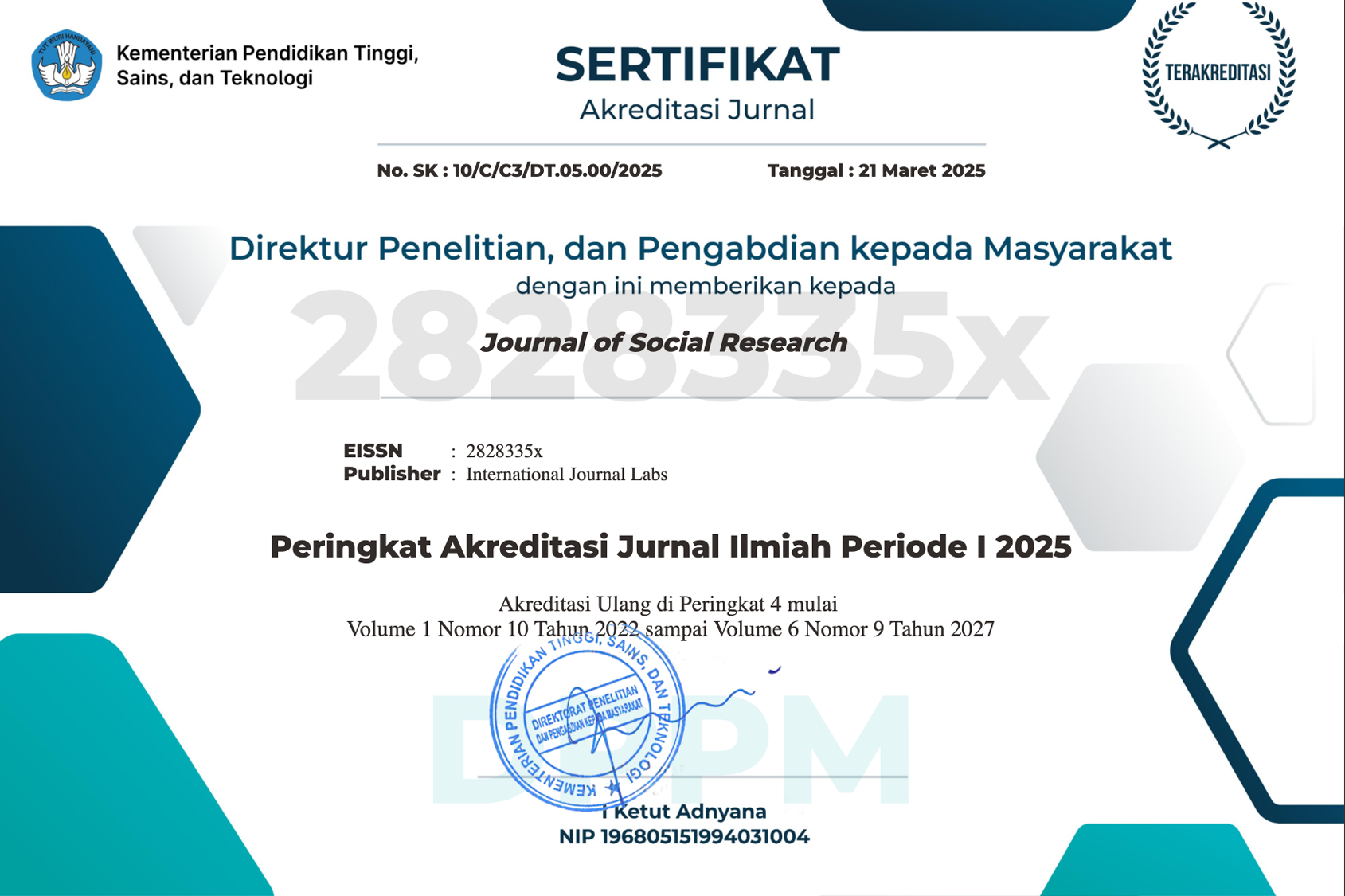



Journal of Social Research is committed to upholding the highest standards of publication ethics, transparency, and research integrity in accordance with internationally recognized scholarly publishing practices.
This policy governs the responsible use of generative Artificial Intelligence (AI) and AI-assisted technologies across all stages of the publication process, including manuscript preparation, peer review, and editorial decision-making. AI tools must not replace human intellectual contribution, critical thinking, or scholarly judgment. Authors, reviewers, and editors remain fully responsible and accountable for the integrity, accuracy, and originality of all submitted and published work.
Journal of Social Research affirms that all scholarly work must be the result of human intellectual effort. The use of AI tools is permitted only as a supportive mechanism and must not substitute for:
critical analysis;
methodological rigor;
scholarly interpretation; or
academic judgment.
Authors bear full responsibility and accountability for the integrity, validity, and originality of all submitted content, including any portion supported by AI tools.
Authors may utilize AI tools under the following conditions:
to improve language quality, grammar, clarity, and readability;
to assist with the structural organization of the manuscript; and
to support preliminary idea exploration, provided that all outputs are critically evaluated.
AI tools must not be used to autonomously generate:
research findings;
data analysis;
interpretation of results; or
scholarly conclusions without substantial human validation.
All AI-assisted content must undergo rigorous human verification to prevent inaccuracies, fabricated citations, or biased outputs.
To ensure transparency and reproducibility, Journal of Social Research requires explicit disclosure of AI usage:
A dedicated “AI Disclosure Statement” must be included in the manuscript prior to the references section.
The disclosure must include:
the name and version, if applicable, of the AI tool;
the specific purpose of its use;
the extent of its use; and
confirmation of full human oversight and responsibility.
Standard format:
“The authors used [AI tool name] solely for [specific purpose, e.g., language editing and structural refinement]. All outputs were critically reviewed, validated, and revised by the authors. The authors take full responsibility for the content of this manuscript.”
Routine spelling and grammar checks do not require disclosure.
If AI tools are employed as part of the research design or methodology, their use must be described in detail in the Methods section to ensure methodological transparency and reproducibility.
Authors must ensure that the use of AI tools does not compromise:
the confidentiality of unpublished manuscripts;
the protection of research data and participant privacy; or
intellectual property rights.
Authors are required to review the terms of service of AI tools to ensure that no unintended data sharing, storage, or reuse occurs, particularly in relation to sensitive or proprietary materials.
Journal of Social Research strictly prohibits the use of generative AI for:
creating, altering, or manipulating figures, images, or graphical representations; and
producing graphical abstracts or other visual research outputs.
An exception is permitted only when AI constitutes an integral component of the research methodology, such as AI-based image analysis. In such cases:
the methodology must be described in a transparent and reproducible manner;
technical specifications, including the tool name, version, and parameters, must be provided; and
original data may be requested for verification during the review process.
AI tools do not meet the criteria for authorship and must not be listed as authors or co-authors.
Authorship is limited to individuals who:
make substantial scholarly contributions;
participate in drafting or revising the manuscript;
approve the final version; and
agree to be accountable for all aspects of the work.
To maintain the integrity and confidentiality of the peer review process:
Reviewers are strictly prohibited from uploading manuscripts or any part thereof into AI systems.
AI tools must not be used to generate, draft, or refine peer review reports.
Peer review requires independent human evaluation, and reviewers remain fully accountable for their assessments.
Editors must not use generative AI tools to:
evaluate manuscripts;
formulate editorial decisions; or
generate decision letters containing confidential information.
Editorial responsibilities require independent expert judgment and must adhere to principles of fairness, confidentiality, and academic integrity.
Journal of Social Research reserves the right to:
request clarification regarding AI usage;
conduct ethical checks during submission and review processes; and
reject manuscripts or retract published articles in cases of policy violations.
Non-compliance with this policy may constitute a breach of publication ethics and will be handled in accordance with established ethical guidelines.
Journal of Social Research acknowledges the evolving nature of AI technologies and commits to periodically reviewing and updating this policy to maintain alignment with international standards, indexing requirements, and best practices in scholarly publishing.

This work is licensed under a Creative Commons Attribution-ShareAlike 4.0 International.


